

MY APPROACH
Movement is more than what we see.
We can observe how someone moves, but that doesn’t tell us everything about what they’re experiencing.
Two people may find the same movement difficult for very different reasons. Even for the same person, what feels possible can change depending on the situation and how they are showing up on the day itself.
That’s why I’m interested in more than what appears tight, weak or restricted.
I’m curious about how we experience movement, what influences it and what might change when we begin to explore.
We experience ourselves as a whole.
What we believe, what we feel, what we sense, how we organise ourselves, and how we choose to act.
Five Dimensions of Our Experience
1
YOUR BELIEFS
The stories you hold about yourself and what you expect might happen.
2
YOUR EMOTIONS
Confidence, fear, curiosity, frustration, joy.
3
YOUR SENSATIONS
Breath, effort, tension, support and all the things you may not yet notice.
4
YOUR ORGANISATION
How you organise yourself to move — where you brace, hold, shift or use effort.
5
YOUR ACTIONS
What you actually do — or avoid doing — and how you move through the world.
These aren’t five separate parts of you. They coexist, and each can influence the others.
Maybe you think: “my balance is terrible.”…
You may expect to wobble. You might feel apprehensive.
Without even noticing it, you hold your breath, stiffen or organise yourself differently.
Perhaps you start avoiding uneven ground or situations where you don’t feel secure.
And that experience can reinforce the story you started with:
“See? My balance really is terrible.”
What if there’s something happening in the way you move that you haven’t noticed yet? That’s where I like to begin.
This is why I don’t begin by trying to correct you.
I begin by helping you notice what is actually happening.
Because what we cannot sense, we rarely have the opportunity to change.
When we sense ourselves more clearly, we have new information.
We may notice effort we didn’t know we were making, discover choices we didn’t realise we had, or experience something that previously felt difficult in a completely different way.
And sometimes, a different experience reveals that the story we’ve been living isn’t the whole story.
POSSIBILITY ISN’T POSITIVE THINKING.
It isn’t pretending limitations don’t exist. And it certainly isn’t believing you can do anything if you want it badly enough.
Some limitations are real.
I’m interested in the space between what we currently believe is possible and what may actually be available to us.
Because this isn’t really about becoming better at movement.
It’s about participating in life.
Getting down onto the floor. Walking somewhere unfamiliar. Running. Playing with children. Travelling. Carrying something. Trying a new activity. Continuing to do the things that matter to us as we get older.
Not everything is possible. But more may be possible than we currently know.
THE S.H.I.F.T APPROACH
There is a framework that guides how I observe, question and explore movement with you.
I call it S.H.I.F.T.
It isn’t a fixed sequence or a programme everyone follows.
These five elements inform how we work together, depending on what matters to you.
S ense
NOTICE YOURSELF FROM THE INSIDE OUT
We start by noticing what is happening now.
How are you breathing? Where is your weight? Where do you feel effort, tension or support? What can you sense clearly — and what might you not have noticed before?
The more clearly you can sense yourself, the more information you have to work with.
Awareness · Attention · Body connection
H armonise
MOVE IN RELATIONSHIP TO YOUR WORLD
Movement doesn’t happen in isolation.
You are constantly responding to gravity, the ground beneath you, your environment, other people, your intentions and how you feel.
We explore how you organise yourself in those relationships — and whether there might be ways to respond with less unnecessary effort, bracing or tension.
Not to control movement perfectly, but to become more adaptable and responsive.
Adaptability · Balance · Ease
I ntegrate
BRING MORE OF YOURSELF INTO MOVEMENT
You don’t move as a collection of separate body parts.
Your breath, attention, sensations, emotions, nervous system and physical movement all influence one another.
We explore how more of you can participate, so that movement can become more connected, coordinated and available.
Whole-self movement · Coordination · Connection
F unction
SUPPORT WHAT MATTERS TO YOU IN LIFE
This is where what we discover meets real life.
Walking. Running. Getting onto the floor. Reaching. Lifting something. Climbing stairs. Training. Travelling. Playing with your grandchildren.
We explore how what you have discovered can support the things you actually want and need to do.
This isn’t movement for movement’s sake.
Everyday movement · Confidence · Participation
T hrive
KEEP DOING WHAT YOU LOVE
Ultimately, this is about your life beyond our sessions.
The aim isn’t to make you dependent on me. It’s to help you become increasingly able to sense yourself, adapt, make choices and trust your own experience.
So that you can keep participating in the things that matter to you — now and as you get older.
Vitality · Longevity · Freedom to move
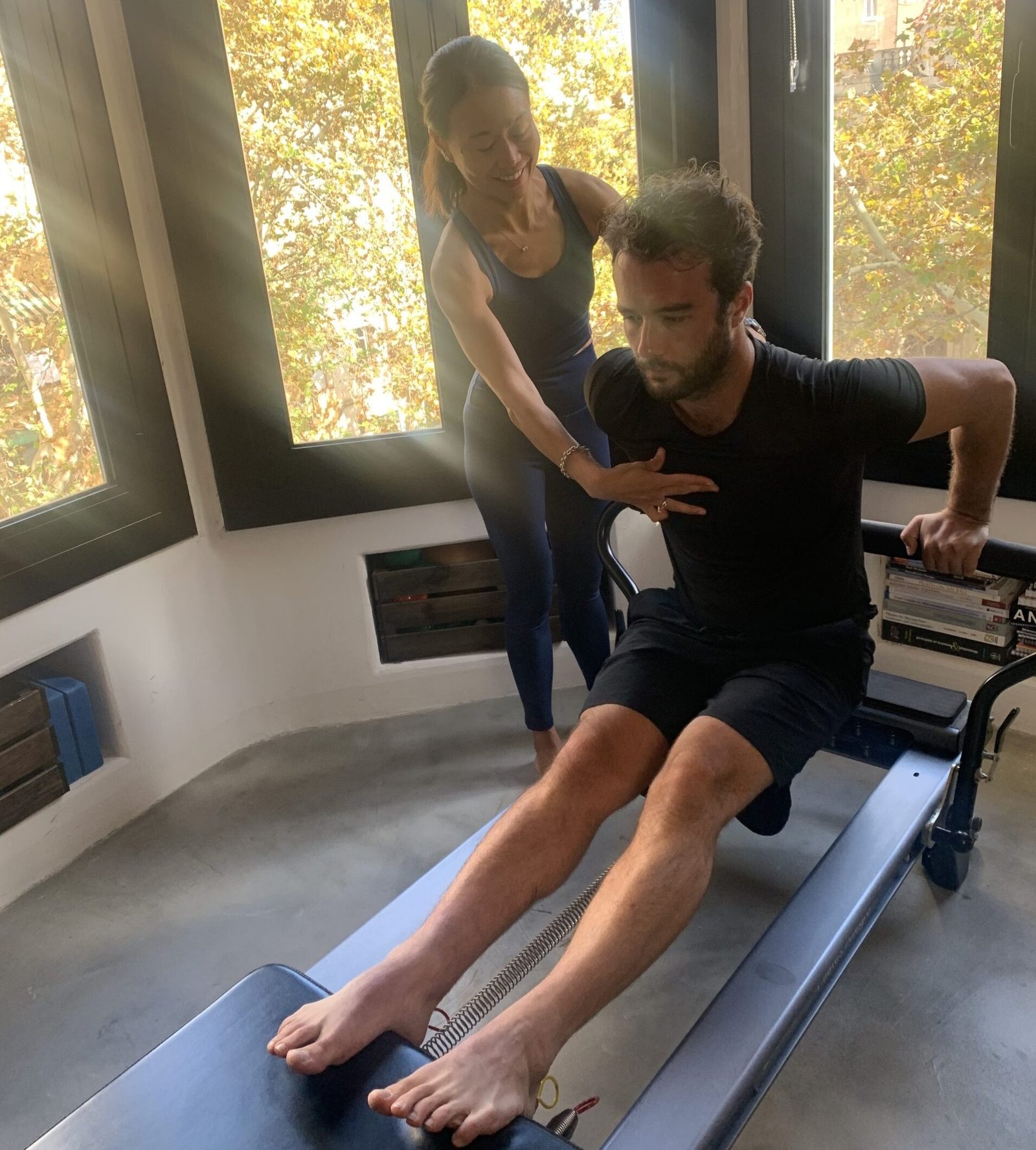
You don’t need to know what’s wrong. You only need to be curious about what might still be possible.
WHERE MY APPROACH COMES FROM
No single method has all the answers.
My work has evolved through years of teaching, studying and, perhaps most importantly, paying attention to the people in front of me.
Clinical Pilates taught me to observe movement carefully and gave me a strong foundation in biomechanics, rehabilitation and function.
The Feldenkrais Method deepened my understanding of sensing, learning and how we discover new possibilities through experience.
Mindfulness taught me something equally important: how to stay curious about what is happening without immediately judging it or trying to change it.
But I don’t treat these as separate methods to apply to you. They have shaped how I see, how I listen and how I work.
My job isn’t to have all the answers for you. It’s to help you become better at discovering your own.
How We Can Work Together
Individual Movement Sessions
Something has changed in how you move or what you feel able to do.
You're more cautious, you've stopped doing something you once enjoyed, or you're simply unsure what your body can do now.
Work with me individually to explore what's getting in the way, notice what you may not have noticed before, and discover what else might be possible.
FORMAT:
Online (worldwide) or In-Person (Barcelona)
Movement Possibilities Academy
Movement is something we can keep exploring throughout our lives.
But it can be hard to make time for your own movement practice. Work gets busy, other things take priority, and despite your best intentions, it's easy to keep putting it off.
The Academy is a community for doing just that. We come together for regular live practices to move, experiment, share what we notice and learn alongside one another.
FORMAT:
Online (worldwide)
Retreats & Immersions
It can be hard to find space for yourself when everyday life is full.
There are meals to think about, work deadlines, errands, chores and people who need something from you. Even when you have time, it can be difficult to really step away from it all.
Retreats and immersions give you time to move, explore and experience yourself in a different setting — and perhaps return to everyday life with a fresh perspective.
NEXT RETREAT:
28-31 May, 2027 | Tossa de Mar, Spain